Tuesday, April 5, 2016

what qualifies you to be loved

I've been thinking a lot lately about the idea of love, familial, platonic, and romantic and what makes a person worthy of it. It seems as though some people are more likely than others to find love, to be in love, and to love others. I wanted to know what made them different than myself.

If you know me at all, you know that I can suppress my emotions like no other. I have them; they are there, but a very lucky few get to witness them. And that's not to say that I don't express emotion at all. I get excited and you can tell when I'm happy. I'm really good at showing anger and frustration. But if you want anything deeper than that, you're gonna have to dig.

And for a while now, I've been trying to figure out what about me, made me incapable of embracing those emotions, whether they were love, or hurt, or sadness. I wanted to know how I could allow myself to express those feelings without having to open myself up and make myself vulnerable. And of course, I haven't figured out a way to do that, because it's not possible. Vulnerability is kind of the backbone to deep emotion. And I'm still learning how to use it.

But this realization did not help me solve my initial problem. I wanted to know what made others so much more likely to find love in all capacities than I felt like I was. I saw people around me falling in love and when you see that so often, it's hard not to want it for yourself. But the problem I was facing was the fact that I was equating love to romance. They are not always the same. I saw roommates and friends with their significant others and I would think about how happy they must be and how much love they must have in their lives. And it's true that they have much more romantic love, but that does not mean that I had a deficit of love in general.


There are four types of love, as established by the Greek culture and language. Eros, the most commonly acknowledged love, is romantic. Philia is platonic, or friendship love, Storge is familial love, and Agape is Christlike love. Movies, books, and other media tell us that Eros is the most desirable of these types of love. Love has become synonymous with romance. But Eros is also the most temperamental kind of love. It rarely has a strong base unless tied to another kind of love as well. Philia is developed based on emotional connection, Storge on family ties, and Agape on the unconditional love for a person based on the knowledge that they are worth loving because Chirst loves them. All of these types of love are strong and necessary and powerful.

I'm trying to figure out how to write this without sounding whiny or desperate. I want to express how I feel but I know how it sounds. The thing is I want to be in love. I see it everyday in my coworkers, my friends, and my family. I see how happy it can make someone. I want someone to love me and I want someone to love. I want to go on cute dates and hold hands and kiss. I want all of those things, but somehow I've connected wanting those things in my mind with weakness. I've gone the overwhelming majority of my life without them and somehow I connect wanting them to submission or dependence. I have lived so much of my life single that I have taught myself that wanting anything else is almost disrespectful to all of the blessings I have in my life right now. And I link feeling this way to shame.

We tear ourselves down when we don't have aspects of Eros in our lives as if it is the pinnacle of love. And then we look for the things that we think might be preventing us from attaining Eros and we minimize those key characteristics of our lives. We look at ourselves and ask "what qualifies me to be loved? and what disqualifies me?" as if love is something you earn based on your looks or personality. We belittle and neglect the other kinds of love in our lives in our search for Eros. We forget that the lack of a romantic relationship in our lives does not make us any less than others. We assume that if we do not have it, we must not be worthy of it.

The truth is nothing can qualify you to be loved. It's not something you earn and it's not something you necessarily deserve either. Everyone is worthy of love in some way. Love is not a gift, but a choice made by yourself and others. Discover all the reasons to love yourself. Find the people in your life that love you for you. That love might be Eros, Storge, Philia, and hopefully Agape, but once you find it, hold on to it for dear life.

Monday, March 28, 2016

change isn't perfect

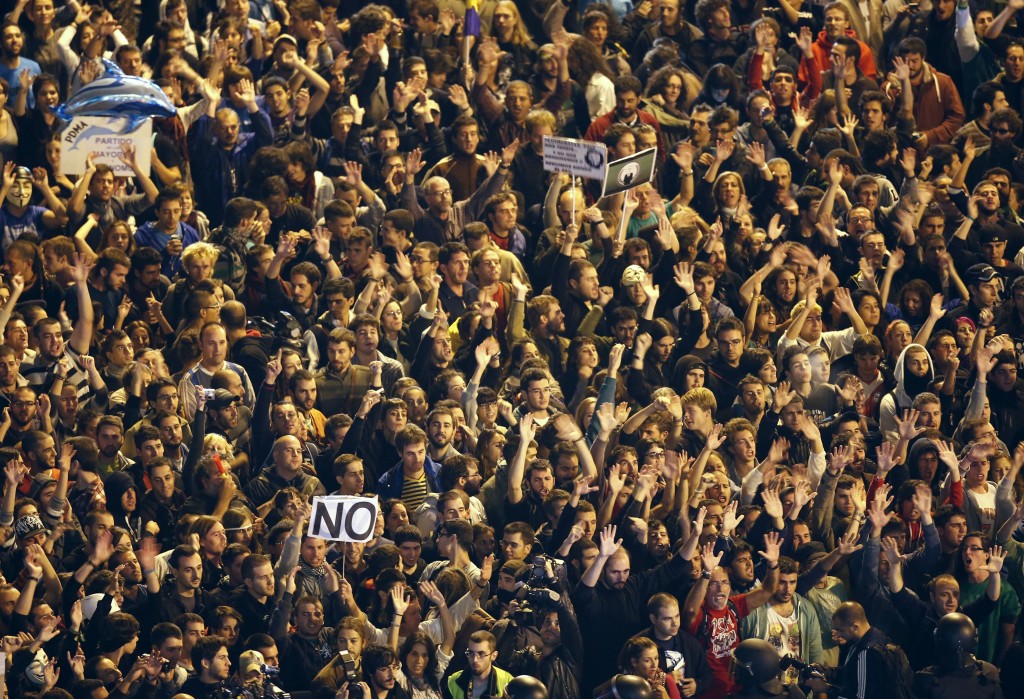
You hear the word "feminism" and you think of women who hate men. You see the hashtag #BlackLivesMatter and you think that the black community is trying to rise above you. You see groups of oppressed people fighting for rights and acknowledgement you've had for years and you think they are trying to threaten the power you clearly have over them.

Spanish protesters in Madrid, September 25, 2012
(taken from https://publicintelligence.net/madrid-athens-protest-photos-sep-2012/)
I've noticed recently that many people are hesitant about human rights movements because they seem to be threatening to the hierarchy. They are; that's the whole point. I had a friend tell me the other day that he did not want to label himself a feminist because his experience with feminism lead him to believe that it was a movement used to give women power. I couldn't argue. That's exactly what it is. It is a movement to give power to women that should be theirs in order to enhance the balance between the sexes.

And the same things go with other human rights movements. We've all seen the argument that #AllLivesMatter. Yep, it's true; they do matter. But you do not solve issues by ignoring the central problem. Black lives matter is focused on the issue that black lives are being devalued. By arguing against the movement saying that it is too focused on one race and needs to be generalized to everyone, you are essentially continuing to devalue the same lives that need to be fought for. Claiming that black lives matter does not decrease the value of other lives, it merely focuses on the issue that black lives need to be more valued than they currently are.

And this is the same with feminism. Yes, the word feminism is gendered. It should be. By saying, human rights or gender equality, you are targeting the same issues but you are taking the focus away from the oppressed to make yourself feel better. The argument that you agree with equality but aren't a feminist is invalid. The spread of #AllLivesMatter is not really progressive at all.

I understand that as a man, the term feminism must be intimidating. You are used to the position of power and privilege that comes from being male. (Note there are other circumstances, i.e. race, sexuality, SES that can cause privilege to fluctuate, but we cannot ignore the inherent privilege that comes with being a man). It's something we have all become used to, women included, so threatening that status quo can be unnerving. But it must be challenged.

[I'd also like to take a moment to say that privilege is not an inherently bad thing. The word privilege has become synonymous with ignorance and discrimination in the social justice community. It's often assumed that the more privilege an individual has, the less they can understand or be beneficial for social justice movements. However, privilege is not a dark mark on individuals with social power, but a useful resource in the fight for equality.]

Okay now back to my point. I think the issue most people have with social movements is that they find flaws in them and therefore justify not fighting for them. But nothing is perfect, and that includes social justice. Sometimes we do the wrong things. Sometimes we fight for the wrong causes. The thing about social justice is that you need to find what you believe in and fight for that. And maybe it doesn't fall perfectly under what you think the umbrella is of feminism or civil rights or LGBT rights. Maybe you think the movements are flawed. But that doesn't mean you sit on the sideline. That doesn't mean you get to say "I believe in equality, but I'm not a feminist." That doesn't mean you get to pick and choose aspects of a movement.

It means that you dive head first into whatever cause you are fighting. You make your voice heard. You fight for truth and you point out when you think the movement might be headed in the wrong way. Advocate for change; fight for a better future. Don't disqualify yourself based on the perceived missteps or shortcomings of others. We can't solve anything when we aren't united. And you're gonna have to unite yourself with a flawed cause, but that's the only way to fix anything. 

Monday, February 22, 2016

on rape, victim blaming, and kesha rose sebert


When I walk to my car at night I pull out my keys before I even go outside and hold them in my hands, the car key held firmly between my pointer finger and thumb. I watch and listen carefully to my surroundings as approach my car. I peer into the backseat before unlocking it.

I took a psychology of gender class last summer and one of the activities we did followed the previous scenario. We were told that we were leaving the grocery store in the dark and were asked what our routine would be. The men of class stated that they merely walked out to their car, got their keys, and left. Women however, noted a more specific routine. All of us recalled retrieving our keys while in the store or while walking toward the vehicle. Some stated that they would take their hair out of a ponytail if it was in one to remove that point of attack. We would check our cars before getting in and lock the doors immediately thereafter. We live with the constant fear and awareness that we can be attacked if we are too vulnerable. This routine could make all the difference in our own safety.

The threat to women on a daily basis is astonishing. Throughout her life, a woman in the US has a 1 in 6 chance of being raped. 44% of victims (both male and female) are under 18 and 80% are under 30. In addition to the revolting statistics involving victims, there are even worse statistics related to the perpetrators. 98% of rapists will never spend time in jail for their crimes. And this is partly because 68% of assaults are never even reported.

These leads me to the question of how our society has developed so that women do not feel comfortable reporting their attackers. A woman should feel not only comfortable, but as if it is her duty to make sure that the assault is reported and that the attacker is convicted and sentenced for their actions. However, our society is set up to immediately doubt and blame victims for what happened to them.

Taken from thehollywoodgossip.com/
I was talking the other day with a friend about Kesha's recent court case and how she was not let out of her contract despite being a victim of physical and emotional abuse for several years. My friend, not being aware of the situation asked what had happened to Kesha. I explained that she had been raped by her producer and was trying to get out of her contract so she would no longer have to work with him. My friend's immediate response was "Oh, but was it consensual?" His initial and natural reaction was to doubt. It's not his fault, society has taught him this. It's taught all of us this and it is a difficult thing to unlearn. But because rape is so common and so damaging, we need to fix the way we react to it.

First, it is extremely difficult for a woman to come forward about a rape accusation. It can take years for someone to come forward with their story. This is because of the way we treat women who have claimed to be raped. Women don't feel comfortable sharing their experiences because they feel shame in the fact that they were attacked. The truth of the matter is that a rape victim should never feel shamed. They cannot be held responsible in any capacity for their attack. Revealing clothing is not an invitation. Intoxication is not an invitation. No one asks to get raped, so why do we continue to perpetuate the idea that a victim's personal behavior and decisions is what leads to their situation?

Then, once someone does come forward with a rape accusation, we look for ways to rid the accused rapist of any blame. The victim was wearing provocative clothing or was drunk or the rapist could not help their urges. We try to apologize for rapists and place blame on victims. And because of this trend, there is not a safe atmosphere for victims to tell their stories and report their abusers.

Kesha is now stuck in a contract with a man who has been abusing her for years. She is stuck there because a judge decided that the money her producer has invested in her career is more important than the career itself. The judge decided that a contract is more important than a woman's physical and emotional safety. We live in a hierarchical world, and unfortunately this world has been consistently placing rapists over their victims. This must stop. Ideally, we would rid the world of rape in general. But if this can't be done, the least we can do is make sure it's more comfortable and safe for victims to tell their stories and pursue the justice they deserve.

Friday, February 5, 2016

space cadet

saltflat
The Mirrored Night Sky © Xiaohua Zhao (China)

If you know me pretty well, you'll know that I love space. I love its vastness and its mystery. We're not truly friends until I have ranted about space and time to you. So if I haven't yet, there's something to look forward to in our friendship. Honestly though, I'm not super into the idea of studying space. I'm not worried about what materials it is composed of, the exact number of stars in a galaxy, or exactly how long it would take me to fly to another planet. Instead I prefer to ponder its mysteries and what they mean for my ideology. It is so peculiar to love something as a whole but not care for the details of its existence. I guess, in a sense, this means that I love space due to its presence in my own existence rather than its existence alone.

I love the idea that we are each a speck on the spectrum of existence. Astronomers estimate there are around 100 billion galaxies in the universe. Yet, despite the infinite quality of space and time, each of us were brought into this time, in this space for a reason. We are just a speck among the vastness, but how beautiful it is that we even exist at all.

One of my favorite lines of poetry is the following:

Though my soul may set in darkness, it will rise in perfect light;
I have loved the stars too fondly to be fearful of the night.

from An Old Astronomer to His Pupil by Sarah Williams

To me this verse represents allowing the vastness and darkness of the universe to represent something brighter and more joyful. I think many people are terrified by the idea of space and its mysterious qualities, but I have always been intrigued and drawn to that mystery. I have truly "loved the stars too fondly to be fearful of the night." And I guess the reason I love the stars so much is because their existence means I exist as well.

But this admiration of our universe and my frustration with the current state of our earth lead me to do some writing of my own. It's a little different than anything I have ever posted and I'm actually quite terrified to be posting it, but I've been thinking a lot about vulnerability so I can't back out now. So here is something I wrote recently that doesn't really count as poetry and doesn't really count as prose. In all honesty I don't even know what it is. Please bear with me.

Gravity

Most people are scared of the dark because it represents the unknown
but I've always found it comforting that there is so much more out there

The night sky glitters with the promise of distant galaxies
and for me 197 million square miles of earth just doesn't seem like enough

I want to travel all across the world
I want to see history and I want to experience culture
I want to escape my own life and live the lives of others
Distant lands beckon me
the spirits of the past, present, and future call out my name
my arms reach out in longing, but my feet are nailed to the floor

I am stuck here in a lousy city in a country so proud of itself that people are ignoring the fact that it's dying
We have lost touch with each other
We care more about our own advancements than the people dying in our wake
I want to incite change
But I just can't figure out how

So I want to travel the world
And when I'm done with the earth
I want to escape her grasp as well

To fly among the stars
To experience the vastness of our universe
To simply escape would mean so much more than a world crumbling underneath my feet

Gravity is the only thing keeping me down.

Saturday, January 30, 2016

no one else will

I was thinking recently about how important it is to say things. I have been writing on this silly blog for nearly a year and a half now. In this time, I have published posts that have seen hundreds of eyes and some that don't seem to even reach the smallest audience. But I keep on writing. Firstly because I love it. I like being able to articulate my views on issues that I find important to me. I also love the reception and response. It is such a compliment to see people appreciating the work I have put in to my thoughts. It's even awesome to receive criticism and start important discussions. And of course, each time I hit publish I hope my writing will be caught up in the whirlwinds of social media and find its way to thousands of readers. But knowing that likely will not happen, I hit publish anyway.

So that got me thinking about what keeps me writing. Why is it so important to me that I put my writing out there even when I know not too many people are going to read it? I could just write these things for myself and keep them hidden away in the depths of my computer, but something drives me to share.


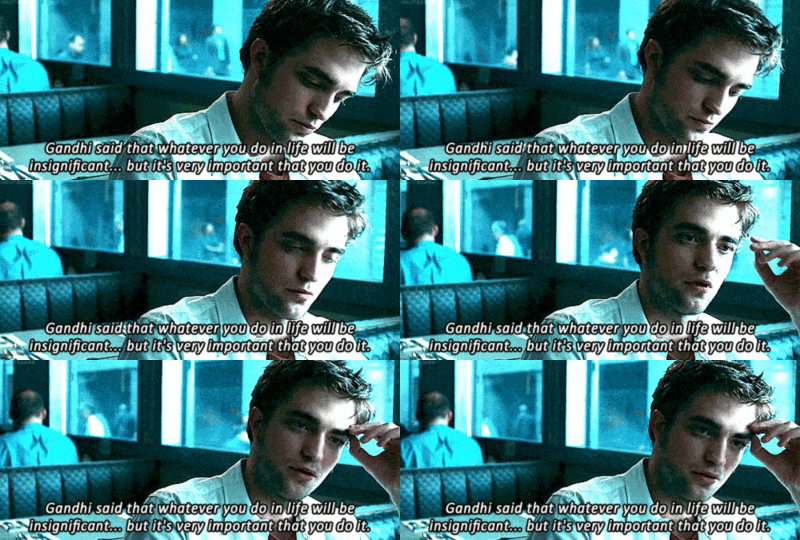
"Whatever you do in life will be insignificant, but it is very important that you do it." This quote might be Ghandi, might be made up, and is definitely used in the film Remember Me with Robert Pattinson.

I've come to terms with the fact that most of what I do will be insignificant in the grand scheme of things. But it's not my job to be significant. It is merely my job to live. And perhaps in that life I will have the blessing of having a positive influence on others. And maybe that influence could somehow be construed as significant. It's not something for me to worry about. 

Dreamboat RPatz, in this film as Tyler, follows up this quote with "because nobody else will." Perhaps everything I have to say has already been said. But maybe it hasn't, and maybe if I'm not the one to say it, no one else will. And I think that's what really keeps me going. I know that whether my words are completely unique or they have been repeated a million times, it's so important that I say them.

We all have important things to say. We have unique perspectives and our thought processes can lead us to ideas that have never been presented before. And it can be really hard to be the person who stands up and speaks out. It's terrifying to put yourself out there. What if I don't have anything new to say? What if I embarrass myself?

This reminded me of the bystander effect. Say you are walking down the street. You see a young couple. You can tell they are in a heated argument and suddenly, one hits the other. You know this kind of behavior needs to be stopped but you are on your way to class. You're running late and you're worried you're not going to make it on time. There are a few other people around so you decide that you will continue to class because one of them is bound to intervene. Unfortunately, there is a good chance these other people are thinking very similar things. One is on their way to a business meeting. Another is on the phone and doesn't want to disturb their conversation. Another is simply timid and doesn't think they will be able to change the situation. But you don't take action assuming someone else will and they all do the same.

This can happen with ideas. You have a thought that you know you need to share, but something stops you. Fear, shame, laziness, the assumption that what you have to say is not important or has been shared before. Whatever it is, you stop and you keep that thought to yourself. It never gets shared. But what if that one thought leads to increased social justice and acceptance? Or maybe that thought is spread and inspires a work of art. Maybe that thought sparks the chain that leads to the cure for cancer. Those words could lead you to love, to friendship, to compassion. Or maybe that idea does nothing for you personally, but leads another person to better self-esteem, happiness, or love.

You can never know the impact of what you have to say. So it's important that you say it. Maybe someone else will, but maybe they won't. And our words might be completely insignificant, but it's so crucial that we say them. We just have to remember that there is so much more to gain from sharing our thoughts than there is to lose.

Friday, January 22, 2016

how to be wrong


I'm the kind of person who does not give up an argument easily. If we start a debate, it's really hard for me to end it. I have to feel like I have won. This is mostly because I am really passionate about my beliefs but also because I am insanely stubborn. Once I have come to a conclusion about something, I will usually stick to that stance. I am not easily swayed. Take that as a warning if you ever want to argue with me.

Also note that I live in a logical world where there is a sensible answer to any problem. I rely on reasoning more often than I really should. On the Myers Briggs personality spectrum, I am definitely on the thinking side of the thinking/feeling dichotomy. And when asked what my biggest fear is, I reply with the cheesy, almost invalid answer of "not understanding." When I don't grasp a subject, I'm quick to decide that it's pointless and not worth pursuing. Seriously, just ask my high school calculus teacher.

But recently, I have discovered that it is important to recognize that you aren't always going to be right. Your opinion isn't perfect, you won't understand everything, and truth will always be subjective. I think I discovered this in a selfish way. When other people didn't agree with me and I wanted them to become more willing to admit their own faults. But I am begrudgingly admitting that this is something I need to do as well. And it kinda sucks. Admitting that you are wrong is one of the hardest things to do. It takes a shot at your dignity and opens yourself up to judgment. No one wants to be the person that changes their mind. In politics, its called flip-flopping and it can kill a campaign. But the truth is the change of opinion and the recognition of fault is essential to growth.

One of the most important things to learn in life is how to be wrong. We often float around in a dream world where all of our thoughts are truth. We are right and we shouldn't change our thoughts, behaviors, and characteristics because it's a sign of weakness. The phrase "you've changed" typically has a negative connotation as if change is unwanted or weak. But change is pretty key to our own growth.

To an extent, our thoughts and ideas are our own personal truths. But we must be careful to not project these things onto others. Our beliefs won't always be right for everyone and it can be hard to come to terms with that. But we also have to recognize that what we see as our own personal truth may not be completely correct or healthy for ourselves. We might think we're right and that our decisions are our own business, but others can often add a perspective to our view of our decisions and its important to listen. I am not always right no matter how much I'd like to think I am, even, and maybe even especially when it comes to the decisions I am making with my own life.

So how do we let ourselves be wrong? In our journey to find objective truth we often come to the conclusion that we are the only ones who can see it. That our truth is everyone's truth. But the fallacy in this journey is that there isn't really an objective truth to find. It's a journey without a destination. And it is much easier to relinquish our ideas of truth when we recognize that objective truth just might be impossible to come by. Once you recognize that truth is subjective and personal, you will find it easier to shift your thoughts and ideas. You will be able to grow and you'll be more able to let others grow as well.

We need to recognize that change is essential to progression. Our lives become stagnant when we let our views and beliefs remain the same when our circumstances change or we are presented with new information. Our friends and family can often provide views that we wouldn't have otherwise considered. We need to realize that revising our thoughts and ideas isn't weakness, it's the strength to identify our faults and readjust. It's the wisdom to admit that we can't always access truth. It's the humility to understand that we might not always have the right answer.

So next time I am stubborn about my own views, I will take a step back and try to see things from another point of view. Because though it's hard to admit, mine isn't perfect, not even for myself.

Tuesday, January 12, 2016

confidence in your insecurities

We spend most of our lives doing two things. First, worrying about what other people think of us, and second, telling ourselves we shouldn't care. We preoccupy ourselves with others' perception of us and we often let them gauge our perceptions of ourselves.

Romantic comedies have conditioned me to expect a gorgeous, tall, dark-haired, light-eyed intellectual stranger to sweep me off my feet. They have conditioned me to believe that one day, the man of my dreams will take off my glasses and everyone will realize how beautiful I was the whole time. I have been conditioned to believe that perfect things and stories happen to ordinary people. It's not a bad hope to have, but it is a bad expectation. Chances are none of those things are going to happen for me (though I'm still hoping for the tall, gorgeous, intellectual stranger part). But I have been taught to believe that if things aren't going right, whether romantically, fiscally, emotionally, and so on, there is something fundamentally wrong with me. Not everything is going to go right in my life. And chances are, I am never going to be satisfied with the way I feel I am viewed by the world. But it's my job to tell myself not to care or worry.

The truth is I do care. I try not to let it affect the way I behave, but I do care. And that's not necessarily a problem.

I'm not here to tell you to stop caring what people think. In fact, I'm here to say that's a horrible idea. Care what people think of you. Care about how you treat others and how present yourself. It is okay to care if the cutie in your biology class thinks you're attractive. It's okay to be disappointed and confused when they don't. It's okay to want your roommates to think you are fun to talk to. It's okay to be a little sad when they don't like you that much. It is not a bad thing to care about your self-image. It's an important part of you. It will help you get jobs, achieve your goals, and make new friends. In fact, caring will probably guide you to becoming a better version of yourself.

A common fallacy perpetuated by both media and our peers is that we need to constantly have an "I don't give a... " attitude. We're not supposed to care what other people think. We're supposed to be self-absorbed and narcissistic. This attitude is also commonly paired with a superiority complex and a disregard for others. We're too busy not caring about what other people think of us to care how they feel about themselves. And in this we find a benefit to caring about what people think of us. When we are concerned about the way people view us, we are more concerned with how we treat them. We realize that the way the people around us feel about themselves is, to an extent, a reflection of our own character.

The trick is knowing when to not care. Don't let that silly boy who doesn't notice you make you think you are not worth noticing. Don't let that girl make you think you are not intelligent or that you don't have important things to say. Know that people will have their opinions of you, but they're just opinions. They are not fact. You design your own self. You are in control of how you broadcast yourself to others. However, you are not in control of their reception.

At this point in my life, I'm trying to figure out how to be confident without being conceited. In all honestly, I truly and deeply love myself. And I love the fact that I've reached this point of self-positivity. It's awesome. But I still have my bouts of insecurity. I get down on myself. I stress about my grades and how they reflect on my intelligence and motivation. I worry about the way I look and how I dress. I'm often anxious about social interactions. Loving yourself doesn't mean you are free from insecurity. Insecurity is natural. Truly loving yourself is realizing you have those insecurities and not letting them determine your self-worth.

So here's the trick. Know who you want to be and become that person. And if you are being the person you want to be, it shouldn't matter what other people think. Use the opinions of others to develop your ideal self, but remember that the most important person to please is you.